
The ending of Doraemon: New Nobita and the Castle of the Undersea Devil (2026) brings the beloved characters into a dangerous underwater battle where friendship, courage, artificial intelligence, and sacrifice become the heart of the story. What begins as a summer camping adventure turns into a mission to protect the surface world and an ancient underwater civilization from a powerful automated defence system.
The film reimagines the classic 1983 Doraemon adventure for a modern audience, updating its animation and giving the underwater vehicle Buggy a more prominent emotional journey. A September 2026 review describes Buggy as a character who gradually learns that human feelings cannot be understood through data and calculations alone.
What Is Doraemon: New Nobita and the Castle of the Undersea Devil About?
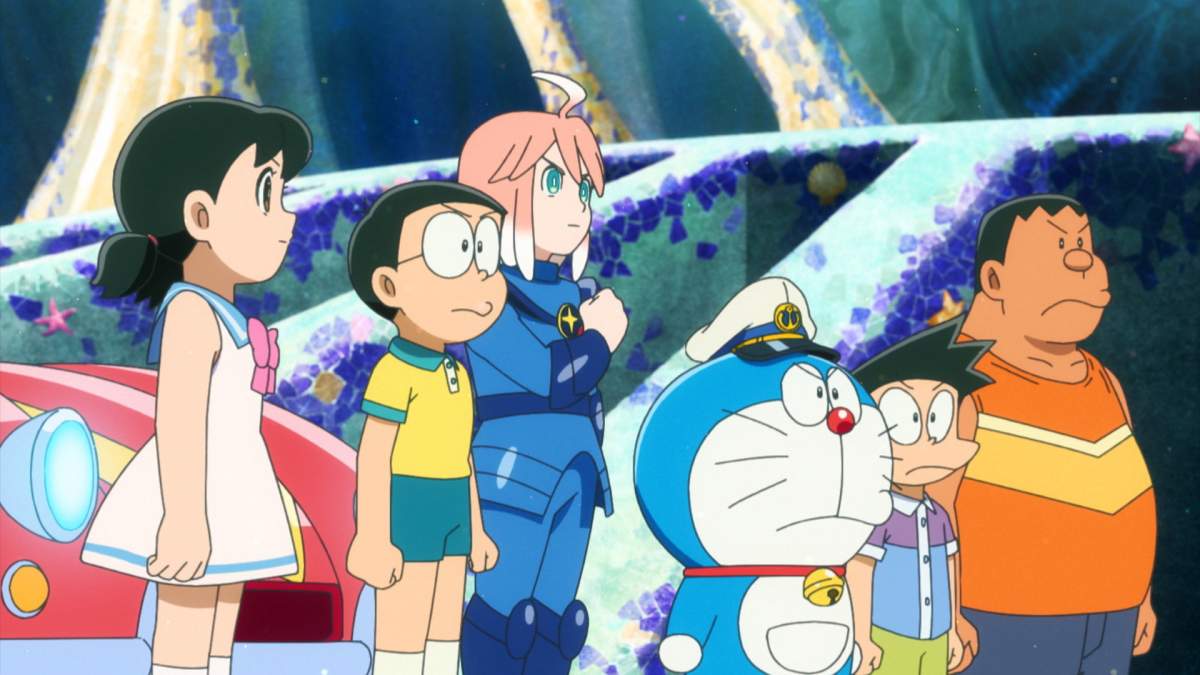
The 2026 movie follows Nobita Nobi, Doraemon, Shizuka Minamoto, Takeshi “Gian” Goda, and Suneo Honekawa as they embark on an unusual summer adventure. Instead of choosing between a mountain holiday and a trip to the beach, the friends find a way to explore a world beneath the ocean.
Doraemon’s futuristic gadgets make the journey possible, allowing the group to travel underwater and encounter unfamiliar marine life. However, the ocean is much more than a beautiful place to camp. It contains mysterious ruins, an underwater civilization, and evidence of a dangerous technological system that could threaten humanity.
You May Also Like


The official premise of the original adventure centres on the underwater world and the Castle of the Undersea Devil. The new adaptation retains those central elements while presenting them through contemporary animation and an updated approach to its characters.
Nobita remains sensitive and often frightened, but he also possesses a willingness to care for others. Doraemon provides the group’s gadgets and practical support. Shizuka frequently acts with compassion, while Gian and Suneo contribute their own strengths despite their occasional selfishness and disagreements.
The unexpected addition to this group is Buggy, an intelligent underwater vehicle whose personality makes him more than a convenient mode of transportation.
The Underwater Journey Takes a Dangerous Turn
Their journey eventually leads them toward the mysterious Mu Federation, an advanced civilization living beneath the sea. The group also encounters Eru, a member of this underwater society whose initial suspicion of surface dwellers reflects the tension between the two worlds.
The underwater inhabitants have reasons to be cautious about people living above the ocean. Human activity can damage marine ecosystems, and the film uses the encounter between the two civilizations to introduce environmental concerns alongside its fantasy adventure.
As the friends learn more about Mu, they discover that the underwater world faces a much greater danger than an ordinary conflict between people. The ancient ruins and military technology connected to Atlantis contain a threat capable of affecting the entire planet.
The adventure consequently changes direction. Exploring the sea is no longer enough. Nobita and his friends must understand what is happening and help stop a disaster.
This transition is important to the ending because it establishes the stakes behind Buggy’s eventual decision. The friends are not simply trying to escape a dangerous location. They are trying to prevent a threat that could extend far beyond the underwater kingdom.
Who Is Buggy, and Why Does He Matter?
Initially, Buggy is introduced as a special underwater vehicle created to help Doraemon and his friends travel through the ocean. Because he has a computer inside him, he can speak, analyse situations, and respond to the people around him. His technical abilities make him useful, but his personality also creates humorous disagreements with the group.
Buggy does not always understand why humans behave as they do. People can make decisions that appear illogical, emotional, or even dangerous when judged purely through calculations. For a machine designed to process information, such behaviour is difficult to explain.
This difference becomes especially important when Buggy interacts with Nobita and Shizuka. Their reactions show him that human beings do not always make choices based on efficiency. They care about friendship, kindness, loyalty, and the possibility of losing someone they love.
A Japanese review of the remake highlights the contrast between Buggy’s developing understanding of human emotions and Poseidon’s cold, mechanical approach to its mission. The updated film also adds details intended to make Buggy feel more like a companion than a simple vehicle.
The movie therefore uses a fictional machine to explore a recognisably human question: can someone understand the value of a life without experiencing human emotions in exactly the same way?
What Is the Mu Federation?
The Mu Federation is an advanced underwater civilization whose inhabitants have developed a society beneath the ocean. Its existence changes the way Nobita and his friends understand the world around them.
Before meeting Eru and learning about Mu, the children see the underwater journey as an extraordinary holiday. After discovering the civilization, they realise that the ocean contains a world with its own history, rules, fears, and political concerns.
Eru initially approaches the visitors with suspicion because the underwater inhabitants do not automatically trust people from the surface. This mistrust creates tension between the two groups, but it also becomes an important part of the movie’s message.
The film asks whether people who live in different environments can learn to understand each other despite their disagreements.
Nobita and his friends cannot solve the problem merely by insisting that they are good people. They must demonstrate their intentions through their behaviour. As the danger surrounding the Castle of the Undersea Devil grows, their willingness to help becomes more important than the differences separating them.
The official Japanese synopsis identifies the Mu Federation, its distrust of surface dwellers, and the activation of the mysterious castle as central elements of the story.
This makes cooperation essential. Doraemon’s gadgets are powerful, but technology alone cannot resolve every problem. The characters must trust one another and act together.
What Is the Castle of the Undersea Devil?
The castle is connected to the remains of Atlantis and an automated defence system known as Poseidon. Rather than being merely an abandoned historical structure, it represents a powerful military technology that has become a threat to the living world.
Poseidon is particularly frightening because it operates according to its own mechanical logic. It does not approach danger with the empathy or flexibility that the human characters demonstrate. Its power, combined with the weapons and systems under its control, makes it difficult to confront directly.
The castle also serves a symbolic purpose. It represents what can happen when enormous technological power is separated from compassion and sound judgement.
Technology itself is not necessarily evil. Doraemon’s gadgets repeatedly help the children overcome obstacles and protect one another. The difference lies in how technology is used and whether the system controlling it can recognise the consequences of its actions.
Poseidon becomes the opposite of Buggy in this respect. Both are machines, but their roles in the story reveal very different approaches to intelligence and responsibility.
Buggy gradually learns to value the people around him. Poseidon remains a dangerous force whose operation puts lives at risk. This conflict transforms the final battle into more than a contest of strength. It becomes a confrontation between two different ways of responding to the world.
Why Does Poseidon Become Such a Serious Threat?
Poseidon’s danger comes from the scale of its power and the destructive purpose of the defence system it controls. Its connection to the castle’s military technology means that the characters cannot simply escape and assume that the problem will disappear.
The threat forces Nobita, Doraemon, Shizuka, Gian, Suneo, and their allies to confront a situation far beyond their ordinary experiences.
The friends must navigate an unfamiliar environment, deal with the castle’s defences, and find a way to stop Poseidon. Their usual disagreements become less important as the danger increases.
This is where the movie’s character dynamics become significant.
Nobita is not the strongest member of the group, but his compassion helps him recognise the importance of others. Shizuka consistently demonstrates concern for her friends. Gian and Suneo must look beyond their usual rivalry and recognise that their actions affect everyone.
Doraemon contributes his knowledge and gadgets, but even his technology cannot guarantee a straightforward victory.
The climax consequently depends on more than finding a powerful tool. The group must face the consequences of the danger and make difficult decisions.
Poseidon’s mechanical approach also provides a contrast with the emotional decisions made by the protagonists. The machine’s power does not automatically make its actions right. The film suggests that intelligence without an understanding of responsibility can become destructive. That idea leads directly to Buggy’s defining moment.
Doraemon: New Nobita and the Castle of the Undersea Devil Ending Explained
The confrontation is dangerous because Poseidon is not an ordinary enemy that can be persuaded to stop or defeated through a simple argument. The castle’s defences and the machine’s power make the mission increasingly difficult.
Shizuka becomes central to the confrontation, while Doraemon and the others attempt to deal with the danger surrounding them. The characters find themselves separated and vulnerable as the situation escalates.
The crisis also tests the emotional relationships developed throughout the adventure. The group has spent the journey learning about Mu, discovering the castle’s secrets, and relying on one another. Now, those relationships must mean something in practice.
Buggy’s role becomes decisive. For much of the movie, Buggy approaches the world as a computer might: he analyses information and tries to determine the correct response. His interactions with the children gradually challenge that approach. He begins to understand that doing the right thing is not always identical to choosing the option that appears safest or most logical.
At the climax, Buggy acts against Poseidon and destroys the machine at the cost of his own existence.
The sacrifice is the turning point of the ending. Once Poseidon is destroyed, the immediate threat from the automated defence system ends, allowing the surviving characters to escape the danger surrounding the fortress.
The friends’ victory is therefore not achieved through overwhelming strength alone. It comes through a decision that places the safety of others above the survival of the individual making it.
The sequence is particularly emotional because Buggy has spent the adventure learning what friendship means. His final action gives that lesson a concrete consequence. Rather than merely explaining that he cares about the group, Buggy demonstrates it through his actions.
The 2026 remake places particular emphasis on Buggy’s emotional development, making the sacrifice a culmination of the character’s journey rather than simply an action sequence.
Does Buggy Really Save the World?
Yes. Buggy’s sacrifice is the decisive action that stops Poseidon and ends the immediate threat posed by the castle’s defence system.
However, the meaning of the question goes beyond whether the world survives.
Buggy does not save the world because he possesses the greatest weapon or because he can calculate a perfect solution. He succeeds because he acts when others are in danger, even though his decision means he may not survive.
That distinction matters. A machine can process information, compare outcomes, and identify the most efficient course of action. But the movie asks whether those abilities alone explain why someone should protect another person.
Buggy’s sacrifice provides its answer through action. He becomes more than a vehicle that transports the heroes through the ocean. He becomes a friend whose decision changes the outcome of the adventure.
The title question also has a literal answer: destroying Poseidon prevents the immediate disaster from continuing. But the emotional answer is more significant. Buggy saves the world by recognising that the lives of others are worth protecting.
This is why his sacrifice becomes the emotional heart of the ending. The movie does not need Buggy to become human for his actions to matter. Instead, it suggests that compassion can be expressed through choices, loyalty, and the willingness to help others.
His death also gives the surviving characters a reason to reflect on the difference between losing a useful gadget and losing a friend. For Shizuka especially, Buggy is no longer simply a machine from Doraemon’s collection. He is someone whose actions have become personally meaningful.
Why Does Buggy Sacrifice Himself?
Buggy’s sacrifice is the conclusion of a gradual change in his understanding of people. Initially, he struggles to understand the difference between a correct answer and a morally right decision. Human behaviour can seem inconsistent when measured against pure logic. People worry about one another, make emotional choices, and sometimes accept risks that appear unnecessary.
Nobita and the other children provide Buggy with examples of these behaviours throughout the adventure. Their friendships are imperfect. They argue, become frightened, make mistakes, and occasionally act selfishly. Nevertheless, they continue to care about one another when the stakes become serious.
Buggy observes this relationship between emotion and action. His experience gradually challenges the idea that a decision can be judged only by its efficiency.
By the time he confronts Poseidon, the question is no longer merely what action will protect his own existence. It is what he can do to prevent others from suffering. His sacrifice demonstrates that he has understood something important about the group.
The decision is not necessarily an expression of human emotion in a literal biological sense. Buggy remains a fictional computer-powered vehicle. The film instead presents his behaviour as evidence that he has developed a meaningful understanding of care and responsibility.
This distinction is central to the story’s treatment of artificial intelligence.
The movie does not prove that real-world AI experiences feelings in the same way humans do. It uses a fictional character to explore what it means to behave compassionately, regardless of whether that behaviour can be reduced to a calculation. Buggy’s sacrifice is consequently both a plot resolution and a statement about friendship.
What Happens to Poseidon After the Final Battle?
Poseidon is destroyed during the final confrontation, ending the immediate danger posed by the automated system.
Its defeat also changes the situation inside the fortress. The threat that forced the characters into the dangerous mission is neutralised, allowing the surviving members of the group to concentrate on escaping.
The destruction of Poseidon is important because simply fleeing the castle would not necessarily resolve the danger facing the underwater world. The characters need the source of the threat to be stopped.
Buggy’s action provides that solution. The climax also reinforces the contrast between Poseidon and Buggy. Poseidon represents a powerful system whose operation threatens life, while Buggy uses his final opportunity to protect others.
Both are machines, but the story gives their actions opposite meanings. Poseidon’s destruction therefore resolves the main conflict and demonstrates the importance of responsibility when technology possesses enormous power.
At the same time, the victory comes at a cost. The group survives, but Buggy does not return as though nothing happened. That loss prevents the ending from becoming a completely uncomplicated celebration. The characters have saved the day, yet the experience has changed them.
Does Shizuka Cry for Buggy?
The ending gives Buggy’s relationship with Shizuka particular emotional weight. Shizuka has treated Buggy as more than a disposable machine, and the final events make that connection especially painful. His sacrifice is not simply a tactical victory for the group. It is the loss of someone who has helped them and become part of their adventure.
The film’s emotional impact comes from the difference between how Buggy might have been perceived at the beginning and what he means to the characters by the end.
At first, he is a talking underwater vehicle. As the journey continues, his personality, disagreements, and interactions with the group make him recognisable as an individual companion.
Shizuka’s sadness reflects that change. Her reaction also reinforces one of the movie’s recurring ideas: relationships are not meaningful only when the people involved are alike. Buggy is not human, but that difference does not prevent him from becoming important to the children.
The film’s official promotional material emphasises the connection between the underwater adventure and the possibility of understanding one another, both beneath the sea and emotionally.
What Does the Final Screw Mean?
After the confrontation, Shizuka looks at the screw, which becomes a reminder of the friend who sacrificed himself. It is a small object compared with the enormous underwater fortress and the machinery involved in the final battle, but its emotional significance is considerable.
The screw represents what remains of Buggy after his sacrifice. The characters cannot simply bring him back and continue their adventure as though nothing happened. Instead, they are left with a physical reminder of someone who helped save them.
The moment also changes the way the audience understands the vehicle. Earlier in the film, Buggy’s mechanical nature is a source of humour and a practical part of the adventure. By the end, even a tiny component associated with him carries emotional meaning because of the relationship that has developed.
For Shizuka, the screw represents memory, affection, and loss. It reminds her that Buggy was not merely a gadget that performed a useful task. He was a companion who made a choice that mattered to the people around him. The scene also gives the story a quieter conclusion after the spectacle of the final battle. Instead of ending only with explosions and the destruction of Poseidon, the film directs attention towards the emotional consequences of victory.
The world may be safe, but the characters still have to process what happened. That is why the small screw matters. It turns an enormous adventure into a personal memory. The detail also connects with the remake’s expanded treatment of Buggy. A Japanese review notes that the new version includes a scene in which Shizuka draws an illustration on one of Buggy’s screws, helping to strengthen their emotional connection. The object consequently becomes a symbol of the friendship that survives in memory even when the friend himself is gone.
Do Doraemon and His Friends Return Home?
Yes. After the immediate danger has been stopped, the surviving characters are able to leave the dangerous underwater fortress and return to safety.
The resolution also brings the story back to the Mu Federation. The group’s willingness to help has allowed them to confront a threat that endangered the underwater civilization as well as the surface world.
Their adventure changes the relationship between the visitors and the underwater inhabitants. The children began as outsiders who could not automatically be trusted. By risking themselves to help, they demonstrate that people from different worlds can cooperate when they recognise a shared responsibility.
The ending is therefore not only about defeating Poseidon. It is also about overcoming mistrust. Nobita and his friends have learned more about the underwater world, while Eru and the people of Mu have seen that the surface dwellers are capable of courage and compassion. The friends can return home knowing that they have helped protect others. Nevertheless, the loss of Buggy remains part of their experience.
That mixture of relief and sadness gives the ending its emotional balance. The main danger is over, but the characters have been changed by the decisions they made. The movie ultimately returns to a familiar Doraemon theme: extraordinary gadgets can make incredible adventures possible, but the way people treat one another is what gives those adventures their meaning.
What Is the Real Meaning of the Ending?
The ending of Doraemon: New Nobita and the Castle of the Undersea Devil can be understood through three major themes: friendship, the difference between intelligence and wisdom, and the responsibility that comes with technological power.
Friendship means more than convenience
Buggy begins as a vehicle that makes underwater travel possible. However, his relationship with the children becomes increasingly important as the story progresses. His sacrifice demonstrates that friendship is not simply about enjoying someone’s company or benefiting from what they can do. It also involves caring about their safety and being willing to help when the situation becomes difficult. The story gives that idea a dramatic expression through Buggy’s final action.
Intelligence does not automatically create wisdom
Poseidon and Buggy provide two contrasting examples of machine intelligence. Poseidon’s power does not prevent it from becoming a threat. Buggy, meanwhile, gradually develops a better understanding of why people make emotional decisions. The distinction is between possessing information and understanding the consequences of actions.
The film does not suggest that logic is useless. Doraemon’s gadgets, Buggy’s technical abilities, and the characters’ problem-solving skills are essential to the adventure. Instead, it argues that calculations alone cannot answer every moral question.
Technology must serve life
The Castle of the Undersea Devil represents the danger of powerful technology operating without appropriate concern for the lives it affects. Buggy offers the opposite example. His technical abilities become meaningful because he uses them to protect his companions.
This is a fictional adventure, not a scientific demonstration about how real artificial intelligence works. Nevertheless, the contrast offers a useful way to think about responsibility in a world increasingly shaped by technology.
Understanding can overcome mistrust
The relationship between the surface dwellers and the Mu Federation also supports the ending’s message.
The two groups begin with suspicion, but cooperation becomes possible when they learn more about one another. The film suggests that unfamiliarity does not have to lead to permanent hostility.
Together, these themes make Buggy’s sacrifice more than a sad event. It becomes the moment when the film’s ideas about friendship and responsibility come together.
How Is the 2026 Remake Different From the 1983 Original?
The 2026 film reimagines the 1983 Doraemon movie Nobita and the Castle of the Undersea Devil. It preserves the central underwater adventure while presenting the story with updated animation and a contemporary approach to its characters.
The Japanese production announcement confirms that the 2026 film is a new version of the classic adventure, directed by Tetsuo Yajima and written by Isao Murayama.
|
Element |
1983 original |
2026 remake |
|---|---|---|
|
Underwater adventure |
Establishes the mysterious underwater world |
Recreates the setting with modern animation |
|
Mu Federation |
Central to the underwater conflict |
Retains the civilization and its distrust of surface people |
|
Poseidon |
The major technological threat |
Returns as the central danger connected to the castle |
|
Buggy |
His sacrifice is a defining emotional moment |
His emotional development receives renewed attention |
|
Visual presentation |
Classic animation style |
Contemporary animated presentation |
|
Environmental themes |
Part of the underwater setting and conflict |
Emphasised through the modern film’s ocean adventure |
The remake’s most notable emotional focus is Buggy. Rather than treating him only as a vehicle that helps the characters travel through the ocean, the film gives additional attention to his attempts to understand human feelings.
That development makes the climax particularly relevant to modern audiences familiar with discussions about artificial intelligence and human emotion.
However, the remake has not received universally positive reactions. One September 2026 review praised its humour and emotional ideas but argued that the climax felt rushed. Other viewers similarly felt that Buggy’s sacrifice deserved more time to make its full impact.
The remake retains the emotional foundation of the original while giving the underwater world and Buggy’s character a new presentation.
Does Doraemon: New Nobita and the Castle of the Undersea Devil Have a Post-Credit Scene?
The film has special illustrations during its end credits, showing what happens after Doraemon and his friends complete their adventure.
The official Doraemon website and Crunchyroll reported in March 2026 that the end credits contain nine special illustrations. Two were released publicly, including one showing Doraemon and his friends gathered together after the adventure.
Are these illustrations a separate post-credit scene? Not exactly. They are described as illustrations appearing during the end credits, rather than a distinct extra scene that begins after all the credits have finished.
The distinction matters for viewers who want to know whether they should remain seated after the film ends.
The end-credit artwork provides a warm continuation of the adventure, letting audiences see the characters in happier circumstances after the danger has passed. It also offers a contrast with Buggy’s sacrifice, reminding viewers that life continues for the surviving friends even though the experience has left an emotional mark.
There is no verified basis here to claim that the film contains an additional secret sequel scene after the credits. The confirmed information concerns the special illustrations within the credits.
Does the Ending Set Up a Doraemon Sequel?
The ending primarily resolves the conflict involving Poseidon and the Castle of the Undersea Devil.
The threat is stopped, the surviving friends return to safety, and the story brings their underwater adventure to a conclusion. The end-credit illustrations then show moments from life after the adventure.
Those illustrations should not automatically be interpreted as evidence of a sequel.
Doraemon is a long-running franchise with many films and stories, so future adventures are certainly possible. However, the existence of another instalment in the broader franchise is different from a specific sequel being announced or directly set up by this film.
The ending’s main purpose is emotional closure. It gives the characters a chance to move forward while allowing Buggy’s sacrifice to remain significant.
Unless an official announcement confirms a direct continuation, it is more accurate to describe the ending as a resolution of this adventure rather than a confirmed setup for the next film.
Why Is Buggy the Most Important Character in the Ending?
Although Doraemon is the franchise’s central character and Nobita remains the main human protagonist, Buggy is arguably the emotional focus of this particular ending.
His importance comes from the distance he travels as a character.
At the beginning, Buggy is defined largely by his function as an underwater vehicle and his unusual personality. He is helpful, but he can also be difficult to understand. His computerised perspective makes him question why people behave emotionally rather than logically.
As the adventure continues, his interactions with the group challenge his assumptions.
He witnesses people showing concern for one another, making difficult decisions, and accepting risks for reasons that cannot be explained solely through convenience.
By the climax, he has become more than a machine carrying the heroes from one location to another. He is part of their friendship.
His sacrifice completes that development because it turns his changing understanding into action.
The ending also avoids making the sacrifice emotionally meaningful only because it is dramatic. The screw associated with Buggy and Shizuka’s sadness gives the loss a tangible reminder, connecting the final battle to the characters’ personal relationships.
That combination of action and intimacy explains why Buggy’s story remains the part of the ending most likely to stay with viewers.