
The Apothecary Diaries Episode 50, titled “The Fire-Rat Cloak,” brings Maomao back into a mystery that begins with an ordinary shopping trip but gradually reveals connections to foreign politics, the western region, and a possible national disaster. While helping Chou-u find warm clothing, Maomao discovers an unusual white garment that a shopkeeper claims belonged to a legendary celestial maiden. Instead of accepting the story at face value, Maomao examines the garment through her practical knowledge and begins uncovering the truth behind its supposed supernatural properties.
Meanwhile, Jinshi continues adjusting to his responsibilities as the officially recognized Imperial Brother. The political situation remains unsettled after the Shi Clan rebellion, and the warning about an approaching disaster continues to trouble him. As Maomao investigates the garment, she begins connecting its unusual material and foreign design to a much larger situation involving international relations and unrest in the western region.
The episode also develops Maomao and Jinshi’s relationship through a quieter, more personal storyline. As Jinshi struggles with exhaustion, Maomao attempts to help him recover in her own unconventional way. Their interaction eventually leads to one of the episode’s most touching moments: Maomao singing a lullaby to help Jinshi fall asleep.
Here is a detailed recap of The Apothecary Diaries Episode 50, explaining the Fire-Rat Cloak mystery, the possible political implications, the approaching locust plague, and the emotional ending involving Maomao and Jinshi.
You May Also Like
Maomao Returns to Her Ordinary Life After the Shi Clan Rebellion
Episode 50 continues after the events surrounding the Shi Clan rebellion. With the immediate aftermath of the uprising becoming more manageable, Maomao has returned to her life as a pharmacist in the pleasure district rather than continuing her duties as a poison taster in the imperial rear palace.
However, returning to familiar surroundings does not mean that Maomao can completely escape the problems affecting the empire. Her ability to recognize unusual details and investigate complicated mysteries continues to make her valuable whenever something suspicious appears.
The political circumstances have also changed significantly. Jinshi has publicly acknowledged his position as the Imperial Brother and has begun taking on more formal responsibilities in government. His new role means that he must pay attention to issues affecting the entire country, not simply the daily affairs of the imperial palace.
The consequences of the Shi Clan rebellion remain relevant, particularly because the western region faces uncertainty. Jinshi is also troubled by the warning about a potential disaster that Loulan entrusted to him before her departure from the story.
These circumstances create the background for the episode’s main developments. Maomao encounters a mysterious garment during an ordinary errand, but her investigation soon reveals that the object may have connections to events far beyond the market.
The episode once again demonstrates how small discoveries can become important when viewed against the larger political situation.
Maomao and Chou-u Visit a Secondhand Clothing Shop
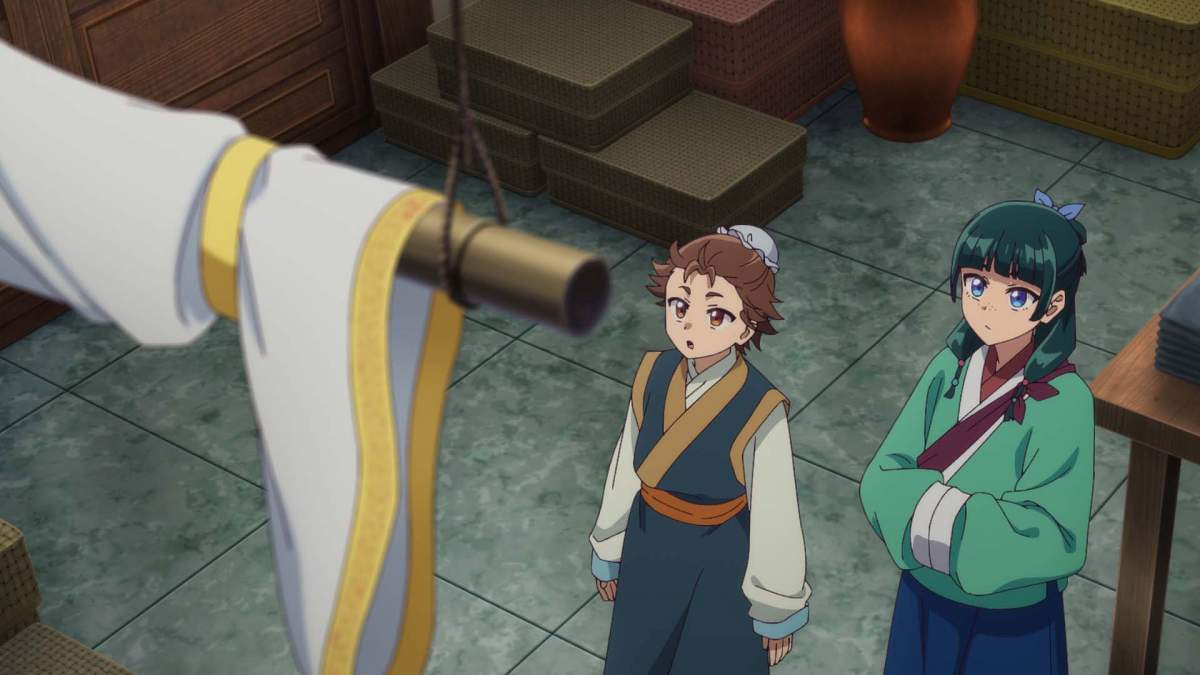
The main mystery begins when Maomao accompanies Chou-u to the market on the main street. She wants to buy a padded jacket suitable for the child, and their outing initially appears to be a straightforward shopping trip.
While examining the merchandise at a secondhand clothing shop, Chou-u notices an unusual white garment hanging on the wall. Its sleeves feature vine-like embroidery, and its appearance suggests that it may come from a foreign culture.
The shopkeeper identifies the garment as the Fire-Rat Cloak and begins telling a story about a beautiful celestial maiden who disappeared into a lake. According to the legend, the garment is connected to the mysterious woman and possesses extraordinary qualities.
For an ordinary customer, such a story might make the garment seem valuable because of its supposed magical origins. A mysterious legend can create an impression of rarity, encouraging buyers to believe that the object is worth considerably more than an ordinary piece of clothing.
Maomao, however, is not easily persuaded by dramatic explanations. Her background as a pharmacist has taught her to examine physical evidence rather than accept extraordinary claims without investigation.
She pays attention to the garment itself, particularly its material and unusual appearance. The story told by the shopkeeper becomes another clue to examine rather than an explanation she must automatically believe.
What begins as a search for children’s clothing consequently becomes a small investigation. Maomao’s curiosity leads her to question whether the cloak really has supernatural properties or whether there is a more practical explanation for its unusual characteristics.
What Is the Secret of the Fire-Rat Cloak?
The Fire-Rat Cloak is the episode’s central mystery, and its importance lies in the difference between the legend surrounding the garment and its actual physical properties.
The shopkeeper presents the cloak as an extraordinary object associated with a celestial maiden. Maomao, by contrast, approaches the claim through observation and knowledge of materials.
She recognizes that the garment’s resistance to fire can be explained without relying on supernatural forces. The material is associated with fire-resistant mineral fibres, known historically in East Asian contexts as fire-washing cloth. The legend of a garment that survives fire has a practical basis rather than necessarily proving that its original owner possessed magical abilities.
This is a familiar pattern in The Apothecary Diaries. Maomao regularly encounters situations in which people attribute unusual events to curses, supernatural powers, or mysterious traditions. Her approach is to investigate the evidence and determine whether medicine, chemistry, or practical knowledge can explain what happened.
The cloak therefore offers a puzzle that suits her abilities perfectly. She does not need to accept the shopkeeper’s story to understand why the garment behaves differently from ordinary fabric.
However, discovering the material’s properties does not resolve every question. The foreign-style embroidery and the story associated with the garment still need to be considered. Maomao begins to suspect that the object’s origins may be more significant than the shopkeeper understands.
The mystery changes from a question about a supposedly magical garment into a question about the people who made it, the knowledge they possessed, and the circumstances that brought it into the market.
Maomao Challenges the Shopkeeper’s Story
Maomao does not stop after identifying the likely explanation for the garment’s unusual properties. She also recognizes that the cloak’s value depends partly on the story attached to it.
The shopkeeper’s account of a celestial maiden gives the object a sense of mystery and rarity. But Maomao understands that an unusual item can attract a higher price when buyers believe it possesses extraordinary origins.
Rather than simply dismissing the garment, she uses her knowledge to challenge the way its value is being presented. Her confidence reflects not only her scientific curiosity but also her practical understanding of commerce.
Maomao grew up in the pleasure district, where understanding people, reading situations, and recognizing opportunities are important survival skills. She knows that information can influence how someone evaluates an object just as much as the object itself.
Her handling of the situation demonstrates that her intelligence is not limited to medicine. She can also use observation, persuasion, and negotiation to achieve a practical result.
The shopping sequence adds a lighter tone to an episode otherwise concerned with political instability and the possibility of a serious disaster. Chou-u’s need for warm clothing remains the original purpose of the outing, and Maomao’s investigation helps turn an ordinary errand into something much more interesting.
Yet the garment’s story continues to matter even after its physical properties become easier to explain. Its foreign design and the legend surrounding its origins provide clues that lead Maomao to consider the wider situation in the empire.
The Celestial Maiden Legend Hints at a Darker History
The tale of the beautiful celestial maiden who disappeared into a lake gives the Fire-Rat Cloak an almost supernatural background. However, Maomao’s investigation encourages a different interpretation of the story.
Instead of assuming that the woman was genuinely a celestial being, Maomao considers whether the legend might conceal a real person and a complicated history.
The garment’s foreign appearance and unusual craftsmanship suggest that the person who made or wore it may have possessed knowledge that was unfamiliar to people in the region. The embroidery also becomes important because its design may contain information beyond simple decoration.
These details lead Maomao to consider the possibility that the story has been transformed over time. An unusual person, a remarkable skill, or an event that people did not understand could eventually become the basis of a legend.
The possibility that the maiden’s story hides something darker is consistent with the series’ treatment of rumours and folklore. Stories often preserve fragments of real events, but the explanations attached to them can change as they are retold.
Maomao’s suspicions extend beyond the question of the garment’s owner. She begins considering whether the story could be connected to foreign visitors, the western region, and the political circumstances surrounding the Shi Clan.
The episode does not require every aspect of the legend to be solved immediately. Instead, the cloak becomes a clue that encourages Maomao to look beyond the market and investigate the wider world.
How the Fire-Rat Cloak Connects to International Politics
The Fire-Rat Cloak’s most important narrative function is that it connects Maomao’s small investigation to a larger political mystery.
The garment’s foreign style and concealed information prompt her to consider the possibility that it originated in circumstances involving international contact. Its craftsmanship suggests that the people responsible for producing it possessed specialized knowledge, while the story attached to it may have obscured the truth about its origins.
Maomao also considers the growing unrest in the western region and the foreign envoys who had connections to the Shi Clan. These details create a larger pattern that she cannot ignore.
The connection is significant because the empire’s political problems do not exist separately from everyday life. Objects, trade, cultural exchange, and the movement of people can all provide evidence about events happening beyond the palace.
Maomao is particularly skilled at recognizing relationships between details that other people might consider unrelated. A garment in a secondhand shop may appear insignificant, but its unusual material and design can provide clues about where it came from and who might have used it.
The episode therefore expands the mystery beyond the immediate question of whether the cloak is genuine. Maomao begins considering whether the legend of the celestial maiden might be connected to espionage or other activities involving people from outside the region.
This remains an interpretation emerging from the clues rather than a reason to assume that every aspect of the legend has been conclusively explained. The important development is that Maomao recognizes the possibility of a political connection and understands that the garment deserves closer attention.
Jinshi Faces the Threat of a Coming Locust Plague
While Maomao investigates the cloak, Jinshi continues dealing with the responsibilities that come with his position as the Imperial Brother.
The political situation is unsettled, and the warning Loulan left behind continues to trouble him. The possibility of a disaster affecting the country is particularly serious because the consequences could extend beyond the imperial court.
One of the episode’s central concerns is the threat of a locust plague. A large-scale locust infestation can destroy crops and undermine food supplies, potentially leading to famine. Such a disaster would affect ordinary families as well as the government, creating problems that could last long after the insects disappear.
The previous episode, “Locusts,” established the importance of this danger. Episode 50 continues that storyline by connecting Maomao’s knowledge and Jinshi’s political responsibilities to the possibility of a national crisis.
The disappearance of the Shi Clan also complicates the situation. Knowledge that might once have been available through the clan’s records and researchers is no longer as easily accessible, making the recovery of important information more difficult.
For Jinshi, the challenge is not simply recognizing that a disaster may occur. He must determine what practical steps can be taken to reduce its impact.
Maomao’s expertise becomes valuable because she is accustomed to investigating problems through evidence and specialized knowledge. Her observations can help Jinshi identify useful information and consider possible solutions.
The locust threat gives the episode a sense of urgency that extends beyond the cloak mystery. While the garment provides clues about foreign connections, the approaching agricultural disaster demands practical action.
Maomao Suggests Searching for the Previous Apothecary’s Research
Maomao recognizes that preventing a locust disaster may depend on recovering information that already exists.
The former apothecary associated with the Shi Clan conducted research on insects, and Maomao believes that another volume of the researcher’s notes may contain information useful for dealing with the approaching infestation.
Her suggestion reflects her usual approach to difficult problems. Rather than relying on speculation or attempting to solve everything through intuition, she looks for evidence, previous observations, and practical knowledge that can be applied to the current situation.
The research notes may offer a better understanding of the insects and possible ways to limit their impact. Even if the records do not provide an immediate solution, recovering them could give the authorities a stronger basis for responding to the threat.
Jinshi takes Maomao’s concern seriously and orders Gaoshun to retrieve the relevant book from the fortress.
This decision is important because it shows Jinshi using his official authority to support an investigation that could benefit the country. Maomao identifies a potentially useful source of information, and Jinshi can arrange for the records to be recovered.
Their cooperation is one of the series’ recurring strengths. Maomao brings scientific curiosity and practical knowledge, while Jinshi has access to the resources needed to act on her findings.
The scene also connects the episode’s apparently separate mysteries. The cloak points toward foreign knowledge and political relationships, while the research notes may help address a disaster threatening the empire’s food supply.
Both storylines show how information can become a powerful tool when people know where to look and how to use what they discover.
Jinshi’s Exhaustion Leads to an Unexpected Conversation with Maomao
As Jinshi continues handling his responsibilities, his exhaustion becomes increasingly apparent.
His new political position requires him to deal with difficult questions while the consequences of the Shi Clan rebellion remain unresolved. The approaching locust plague adds another concern, forcing him to consider the needs of the country alongside his other duties.
Maomao notices that Jinshi needs rest. However, her approach to helping him is characteristically unconventional.
Rather than immediately offering gentle reassurance, she begins considering practical ways to make him relax. Her suggestions lead to a humorous exchange in which Jinshi becomes increasingly uncomfortable with the possibilities she proposes.
The comedy comes from the difference between their perspectives. Maomao approaches the situation with the matter-of-fact attitude of someone who wants to solve a problem, while Jinshi is much more sensitive to the personal implications of her suggestions.
Maomao does not always recognize how her words affect him, especially when she treats matters of intimacy and physical well-being as straightforward practical questions.
Jinshi, meanwhile, is acutely aware of the emotional complications that surround his relationship with her. His reactions reveal that spending time with Maomao means more to him than simply receiving useful advice from a capable pharmacist.
The exchange provides a welcome break from the political tension of the episode. It also allows the series to develop the relationship between the characters without requiring either of them to make a dramatic confession.
Maomao Sings Jinshi a Lullaby
The episode’s most tender moment arrives when Jinshi asks Maomao to stay with him.
After the earlier misunderstandings and jokes, the request creates a quieter atmosphere. Jinshi is exhausted, and what he wants is not another complicated discussion but the comfort of having Maomao nearby.
Maomao responds by singing a lullaby. The song is connected to Fengxian, Maomao’s mother, and her memories of childhood.
The moment is significant because Maomao is sharing something personal rather than simply applying her professional knowledge to a problem. Her willingness to sing reveals a gentler side of her character, even though she does not necessarily interpret the moment as a romantic gesture.
For Jinshi, the lullaby offers an opportunity to rest and experience a rare moment of peace. His responsibilities have placed him under considerable pressure, and Maomao’s presence allows him to set those worries aside temporarily.
The scene also reflects the differences between the characters. Jinshi is more openly affected by their interactions, while Maomao often treats emotional situations with the same practical attitude she brings to her work.
Nevertheless, her actions show that she is capable of offering comfort. She may not express affection in conventional ways, but she can recognize when someone needs help and respond in a way that feels natural to her.
The lullaby is therefore more than a sweet moment between two characters. It connects Maomao’s personal history to her present relationship with Jinshi, creating an emotional scene that contrasts with the political concerns dominating the rest of the episode.
The Apothecary Diaries Episode 50 Ending Explained
The ending of Episode 50 brings together the episode’s mystery, political concerns, and emotional character development.
The Fire-Rat Cloak initially appears to be an unusual garment attached to an old legend. Through Maomao’s observations, however, it becomes a clue that may connect foreign craftsmanship, the western region, and the political circumstances surrounding the Shi Clan.
Although the garment’s fire-resistant properties have a practical explanation, its embroidery and associated story raise additional questions. Maomao begins to suspect that the legend of the celestial maiden may conceal a more complicated history, possibly involving a person who possessed specialized knowledge or was connected to espionage.
Meanwhile, the looming locust plague remains a serious concern. Maomao’s suggestion to recover the former apothecary’s research gives Jinshi a practical next step, and he instructs Gaoshun to retrieve the relevant volume.
These developments demonstrate that the episode’s smaller mysteries are connected to broader questions about the empire’s future. The cloak may reveal something about foreign relationships, while the research notes could help authorities prepare for an agricultural disaster.
The emotional conclusion involving Jinshi and Maomao offers a different kind of resolution. Jinshi is visibly exhausted, and Maomao helps him rest by singing a lullaby associated with her childhood and Fengxian.
Their interaction does not resolve the complications surrounding their relationship, but it reveals a meaningful degree of trust and personal connection. Maomao offers comfort without turning the moment into a declaration of love, while Jinshi receives the opportunity to rest in her presence.
By the end of the episode, the Fire-Rat Cloak mystery has opened the door to further political questions, the locust threat requires additional investigation, and Jinshi and Maomao have shared one of their more intimate moments.
The result is an episode that moves several storylines forward without relying on a single dramatic revelation.