
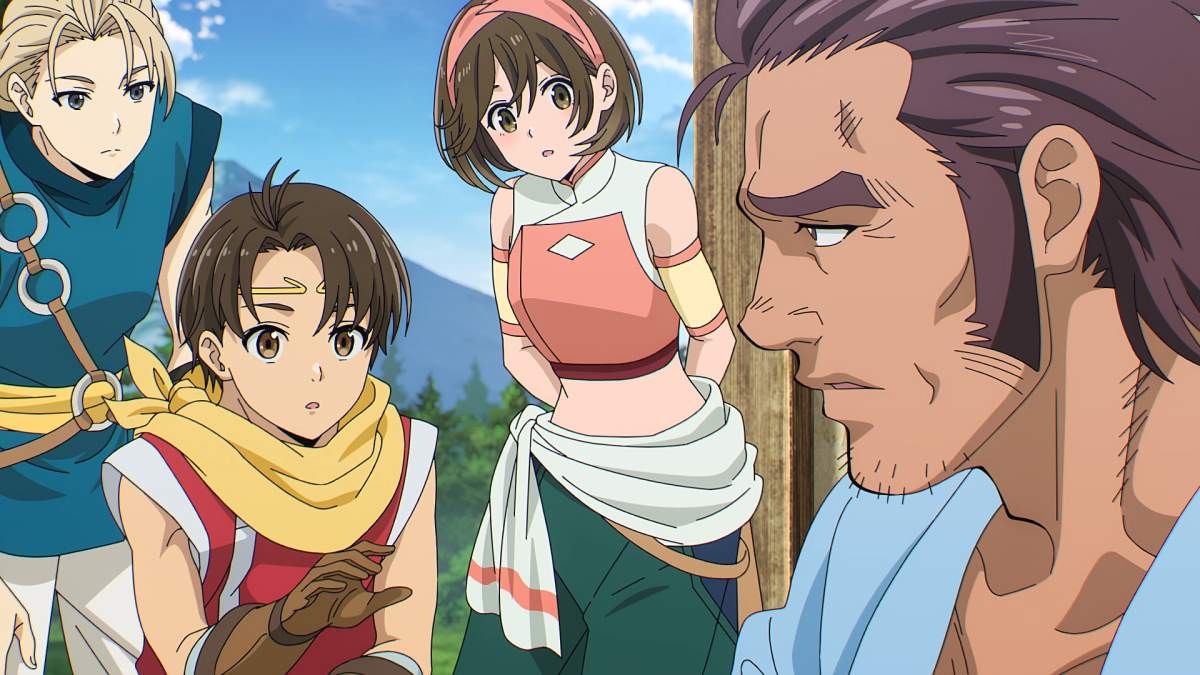
Suikoden: The Anime continues its adaptation of the beloved Suikoden II story with Episode 2, titled “The Mad Prince Luca.” After the shocking events that forced childhood friends Riou and Jowy to flee their homeland, the second episode raises the stakes with a growing military threat, devastated villages, and the introduction of one of the story’s most terrifying antagonists.
The episode shifts the focus from the mystery surrounding the boys’ escape to the brutal reality of the war between the Highland Kingdom and the City-State forces. Riou, Jowy, and Nanami find themselves connected to a conflict far larger than their original mission, while the arrival of military strategist Apple brings an urgent warning about Prince Luca Blight’s advancing army. What follows is a race to prepare the mercenary fortress for an attack that could change the course of the conflict.
For fans in the United States discovering the classic RPG story through its anime adaptation, Episode 2 delivers a mixture of political tension, emotional character moments, and large-scale action. It also begins establishing the central conflict that will shape the journeys of Riou and Jowy.
In this Suikoden Episode 2 review and recap, we break down the major events, explain Luca Blight’s importance, examine the destruction of Ryube and Toto, and discuss the episode’s strongest moments, pacing, animation, and story developments.
You May Also Like
Suikoden: The Anime Episode 2 Begins With a Growing Threat to the Mercenary Fortress
The second episode picks up with Riou, Jowy, and Nanami staying at the mercenary fortress after the events that separated the boys from their homeland. Their immediate situation has changed, but their larger problems are far from resolved. They are now caught between opposing military forces, and the conflict surrounding them is becoming increasingly dangerous. The fortress offers temporary protection, yet its location makes it a potential target as the Highland army continues its advance.
The atmosphere changes when Apple, a military strategist working with the City-State forces, arrives with urgent information. Prince Luca Blight is leading the Highland army toward the mercenary fortress, creating an immediate threat to everyone inside. The warning forces the defenders to consider how they can withstand a powerful military force that appears determined to crush opposition.
This opening is effective because it quickly establishes the episode’s main conflict. Instead of allowing Riou and Jowy to spend more time investigating their escape, the story pushes them into a war that is growing beyond their control. The characters must make decisions while facing incomplete information, limited resources, and an enemy whose reputation is becoming increasingly frightening.
For returning fans of Suikoden II, the fortress setting also serves as an important reminder that the story is about more than the personal journeys of its two protagonists. The war affects soldiers, ordinary villagers, political leaders, and people who have little control over the decisions made by those in power. Episode 2 begins connecting these different perspectives while preparing viewers for a much larger confrontation.
Apple Warns the Heroes About Prince Luca Blight
Apple’s arrival gives the episode a clear sense of urgency. As a strategist, she understands that the Highland army’s movement toward the fortress is not an ordinary military development. Luca Blight is a dangerous opponent whose approach demands immediate preparation, and the defenders cannot assume that conventional tactics will be enough to stop him.
Apple brings intelligence that changes the priorities of Riou, Jowy, Nanami, and the mercenary leaders. The group must consider how to strengthen the fortress before the enemy arrives. Her warning also reveals the limitations of the position they occupy. Although the defenders possess capable fighters and a willingness to resist, courage alone cannot guarantee victory against a much larger force.
The episode uses Apple to introduce the strategic side of the conflict without losing sight of its emotional consequences. Military planning becomes more than a discussion of weapons and troop movements because the outcome will determine whether entire communities survive. Every decision has consequences for people who are not necessarily involved in the conflict by choice.
Apple is also an interesting character because intelligence does not automatically make someone prepared for every situation. A strategist can understand conventional warfare and still be caught off guard by an opponent who uses overwhelming violence or unexpected methods. That tension becomes increasingly important as Luca’s campaign unfolds.
Her warning sets the stage for the next major development: the attempt to obtain a powerful weapon that might give the mercenary fortress a fighting chance.
Riou and Jowy Travel to Ryube to Find Tsai
With Luca’s army approaching, Viktor sends Riou and his companions toward the village of Ryube to find Tsai, a skilled figure known as the Spear of God. Their mission is connected to securing the weaponry needed to defend the mercenary fortress. Rather than waiting passively for the attack, the group must help prepare the resources that could determine the outcome of the coming battle.
This part of the episode expands the world of Suikoden by showing how military resistance depends on more than the strength of individual warriors. A fortress needs weapons, supplies, skilled people, and a plan for using its resources effectively. Riou and Jowy are increasingly involved in these practical concerns, even though they began their journey as young soldiers trying to understand why their original mission went wrong.
The trip to Ryube also creates a contrast between the urgency of military preparations and the ordinary life of a village. Places such as Ryube and Toto are not merely locations on a battlefield map. They are communities where people live, work, and maintain relationships, often far removed from the ambitions of rulers and commanders.
That contrast makes the danger facing the characters more personal. The threat is no longer limited to a confrontation between armies. If Luca continues his advance, the people living in his path will face the consequences regardless of their involvement in the political struggle.
The mission therefore becomes a turning point for Riou and Jowy. They are beginning to understand that surviving the war may require them to take a position within it, especially when the violence threatens people who cannot defend themselves.
Luca Blight Shows Why He Is Such a Terrifying Villain
Prince Luca Blight is the central source of fear in Episode 2. His arrival changes the tone of the story because he represents a form of power that is not restrained by compassion or respect for ordinary people. Rather than treating the war as a contest between opposing military forces, Luca uses violence to establish dominance and intimidate anyone who might resist him.
The episode portrays his cruelty through his treatment of people caught in the Highland campaign. His infamous brutality, including the chilling command associated with the phrase “Die, pig,” reinforces the idea that he views human lives as disposable. These moments are disturbing because Luca does not appear troubled by the suffering he causes. His behavior suggests that terror is not an unfortunate consequence of his campaign but an instrument he willingly uses.
A strong villain needs more than the ability to defeat the heroes in combat. Luca is frightening because his actions create uncertainty about what he might do next. Ordinary rules of negotiation and restraint appear ineffective against someone who can destroy a community without hesitation. This makes him a threat not only to the mercenary fortress but also to the moral expectations of the characters who oppose him.
The adaptation’s depiction of Luca has already become a major talking point among viewers familiar with the game. Some fans have praised how unsettling his behavior feels in the anime, while others have questioned whether certain performance choices fully preserve his menace. Even with those differing reactions, his role in the episode is clear: he establishes a level of danger that the protagonists cannot ignore.
By the end of the episode’s major developments, Luca is no longer simply a name associated with the approaching Highland army. He has become a direct symbol of the cruelty that Riou and Jowy will have to confront.
The Destruction of Ryube Raises the Stakes
One of Episode 2’s most significant developments is the attack on Ryube. The village becomes another casualty of Luca’s advancing campaign, demonstrating that the conflict is spreading beyond military strongholds. The destruction also makes the danger immediate for Riou and his companions, who have traveled there as part of the effort to prepare for the coming battle.
The burning of Ryube reinforces one of the story’s central themes: war rarely remains confined to the people who declare or command it. Ordinary residents pay the price for decisions made by powerful figures, and even communities with no meaningful influence over the conflict can become targets. The village’s fate makes the Highland army’s advance feel like a threat to an entire region rather than a conventional military operation.
Rikimaru’s presence during the events surrounding Ryube gives the sequence additional relevance. The adaptation uses supporting characters to connect the larger conflict with individual experiences, making the destruction more than a brief report of military progress. The suffering of people caught in the campaign helps viewers understand the practical consequences of Luca’s cruelty.
The scene also changes how the audience sees the protagonists’ mission. Obtaining weapons for the fortress is still important, but the devastation around them shows why the effort matters. If Luca is allowed to continue unchecked, other villages could face the same fate.
For Riou and Jowy, these events make neutrality increasingly difficult. They can no longer think only about returning home and uncovering the truth behind their escape. The war is reaching people whose lives matter to them, and that reality begins to shape their decisions.
Jowy Reunites With Pilika in the Ruins of Toto
The emotional center of the episode comes when Jowy reaches Toto and reunites with Pilika. Instead of finding the peaceful community he hoped to see, he discovers the devastating consequences of Luca’s advance. The village has been burned, and the destruction leaves little room for the comfort or familiarity associated with home.
Pilika’s situation makes the scene especially painful. She is a child who has been exposed to terrifying events that she cannot fully understand, and the destruction around her represents a sudden loss of safety. Jowy’s reunion with her brings the consequences of the war into sharp focus because he is no longer dealing with an abstract military threat. He is confronting the suffering of someone he cares about.
The episode allows this moment to contrast with its more action-oriented sequences. While battles and weapons demonstrate the physical scale of the conflict, Pilika’s distress reveals its emotional cost. The destruction of a village can be described in terms of buildings and casualties, but the experience of a frightened child gives that destruction a more personal meaning.
Nanami’s attempt to comfort Pilika adds another layer to the scene. Her intentions are compassionate, and she wants to help the child cope with the loss she has experienced. However, the scene has prompted discussion among viewers about whether the reassurance she offers is emotionally appropriate for someone who has just endured such trauma. The moment illustrates how difficult it can be to comfort another person when there are no easy answers.
Jowy’s reaction also strengthens his character development. Seeing the damage to Toto gives him a powerful reason to oppose Luca. The conflict is no longer simply something he must survive; it is something he increasingly believes must be stopped.
Why Riou and Jowy Decide to Fight Alongside the City-State
The destruction of Ryube and Toto changes the way Riou and Jowy understand their situation. Earlier, their main objective was to return to Kyaro and discover the truth about the events that forced them to flee. Their escape was driven by the need to survive and reunite with the people they knew. However, Luca’s campaign makes it increasingly clear that returning to their old lives may not be enough.
The boys now have direct evidence of the damage caused by the Highland army. They have seen communities destroyed and people left vulnerable by a conflict they did not choose. Their decision to fight alongside the City-State forces develops from this experience, giving their involvement in the war a stronger emotional foundation.
This is an important stage in their character arcs because it marks a shift from survival toward responsibility. Riou and Jowy are still young, and they do not possess the experience of seasoned commanders. Nevertheless, they are beginning to recognize that their actions can influence what happens to others.
Their decision also raises questions that will become increasingly important as the story develops. What does it mean to fight for a cause? Can violence be justified when it is used to resist cruelty? And how should someone respond when the side they choose is imperfect but offers the best chance of protecting innocent people?
These questions are central to the broader Suikoden II narrative. The story does not simply present war as a contest between heroes and villains. It explores how political circumstances, personal loyalties, and painful experiences shape the decisions people make.
By connecting Riou and Jowy’s commitment to the destruction of Toto, Episode 2 gives their developing role in the resistance a clear emotional motivation.
The Dragon Flame Spear Becomes the Fortress’s Best Hope
As Luca’s army approaches the mercenary fortress, the defenders prepare to use a powerful new weapon known as the Dragon Flame Spear. The weapon represents an attempt to counter the Highland army’s military strength with a technological advantage that could make a difference in the coming confrontation.
Its introduction is important because it connects the episode’s earlier mission to the battle that follows. Riou and his companions were sent to seek help obtaining the resources needed to resist Luca, and the fortress’s preparations show why that effort matters. The weapon is not merely an impressive addition to the arsenal; it is part of a broader plan to give the defenders a chance against an enemy who appears to have the advantage.
The Dragon Flame Spear also contributes to the visual identity of the episode’s action. Rather than relying entirely on individual sword fights or displays of personal strength, the conflict incorporates a weapon designed to affect the battlefield itself. This gives the confrontation a larger scale and reinforces the importance of planning, engineering, and coordination in warfare.
However, the weapon does not eliminate the danger. Luca’s forces remain powerful, and the defenders cannot assume that a single tactical advantage will guarantee victory. The siege still depends on how effectively the mercenary leaders deploy their resources and respond to the enemy’s movements.
This tension helps the episode build toward its final confrontation. The defenders have prepared their weapon, but the outcome remains uncertain. The Dragon Flame Spear offers hope, not certainty, and that distinction keeps the battle from feeling like an easy victory waiting to happen.
The Battle at the Mercenary Fortress Begins
The episode reaches its major action sequence when Luca and the Highland army arrive at the mercenary fortress. The defenders must now put their preparations to the test against the force they have been warned about. The confrontation brings together the different threads introduced earlier: Apple’s intelligence, Viktor’s preparations, the search for a weapon, and Riou and Jowy’s growing commitment to resisting Luca.
The battle is effective when it emphasizes the momentum and physical consequences of the fighting. Attacks carry weight, the defenders must respond quickly, and the presence of the Dragon Flame Spear gives the conflict a distinct tactical element. The action also reinforces the difference between a planned defense and an army that relies on overwhelming aggression.
For viewers who have followed the games, seeing the mercenary fortress confrontation animated offers a chance to experience a familiar sequence through a new medium. The adaptation adds its own framing and character moments, even as it works within a story that many longtime fans already know.
The battle also gives supporting characters an opportunity to contribute to the defense. A large-scale conflict becomes more convincing when victory depends on multiple people rather than a single protagonist. Viktor and the other defenders must work together, and their choices determine how effectively the fortress can withstand the assault.
At the same time, the fast pace means that some moments pass quickly. The episode moves rapidly from the warning about Luca to the destruction of villages and the confrontation at the fortress. This keeps the narrative urgent, but it can also reduce the time available to explore individual reactions.
Even so, the battle succeeds in establishing the immediate stakes for the next episode. The defenders are now facing the threat directly, and the outcome of the siege could reshape the protagonists’ future.
Episode 2 Review: Animation, Action, and Pacing
From a review perspective, Episode 2 is strongest when it combines the brutality of Luca’s campaign with the emotional consequences of the destruction he leaves behind. The scenes involving Pilika and the ruined village of Toto provide a human perspective that complements the larger military conflict. These moments help distinguish the episode from a straightforward sequence of battles.
The action also has moments of impact. The Dragon Flame Spear gives the siege a recognizable visual centerpiece, while the arrival of the Highland army creates a sense of escalating danger. Some viewers have praised the quick momentum and physical weight of the combat, although reactions to the animation and character designs have been mixed.
The most consistent criticism is the pacing. Episode 2 covers a substantial amount of story in a limited amount of time, moving between strategic developments, village destruction, character reunions, and the fortress battle. That structure keeps the plot moving, but it leaves less room for quieter interactions that could deepen the audience’s attachment to the characters.
This issue is especially noticeable for viewers unfamiliar with Suikoden II. Longtime fans already understand the significance of many characters and events, so they may fill in emotional context that the anime has limited time to establish. Newcomers, by contrast, may appreciate the dramatic developments but wish the story spent more time explaining why particular relationships matter.
The adaptation also makes choices about which details to include or omit. Such decisions are understandable in a condensed television format, but changes to meaningful character moments can affect how later events resonate. The challenge is to preserve the central story while allowing each important development enough emotional space.
Overall, Episode 2 has strong dramatic material and a clear sense of escalating danger. Its main weakness is not a lack of events, but the speed at which those events unfold.
What Episode 2 Means for the Future of Suikoden: The Anime
Episode 2 establishes the conflict that will shape Riou and Jowy’s journey moving forward. Their original goal was to return home and uncover the truth behind the events that forced them to escape. However, the destruction of Ryube and Toto demonstrates that the war is already affecting people beyond the military forces involved in it.
Luca Blight’s campaign provides the immediate threat, but the story’s larger questions extend beyond defeating one enemy. Riou and Jowy must decide what kind of people they want to become in a world where political power can be used to protect communities or destroy them. Their choices will be shaped by loyalty, friendship, personal experience, and the difficult demands of war.
The episode also begins establishing the importance of supporting characters such as Apple, Viktor, Nanami, and Pilika. Their roles help show that the conflict cannot be understood through the protagonists alone. Military strategy, personal relationships, and the experiences of ordinary people all influence the direction of the story.
For viewers who have not played the original game, this episode provides an introduction to the wider conflict while leaving plenty of questions unanswered. Why did the protagonists’ original mission end in disaster? How far will Luca go to achieve his objectives? And what will Riou and Jowy have to sacrifice as they become more deeply involved in the resistance?
These questions create momentum for the next installment. The fortress battle is not simply an isolated action sequence; it is part of a larger struggle that will test the characters’ beliefs and relationships. The episode therefore works as a transition from the mystery of the first installment to the wider military and political story that defines Suikoden II.
Related – Romelia War Chronicle Episode 2: A New Challenge Changes the Story